If you're renting in Greater Boston, your monthly rent payments could be more valuable than you realize. Changes in mortgage credit scoring and Massachusetts first-time homebuyer assistance programs may make homeownership more accessible than you think.
If you're paying $3,000 a month in rent, that's $36,000 a year. Over five years? That's $180,000 in rental payments, assuming your rent never increases.
Now, here's something that might surprise you.
You could pay your rent on time every single month for years, and those payments might not even appear on your credit report.
For renters throughout Greater Boston, including Norwood, Newton, Needham, Waltham, Watertown, Dedham, and surrounding communities, this can create an unexpected obstacle when it's time to purchase a home.
But changes in how mortgage lenders evaluate credit could help open the door to homeownership for more renters.
And when you combine those changes with Massachusetts programs offering up to $30,000 in down payment assistance for eligible buyers, the opportunity is worth exploring.
Why Your Rent Payments Might Not Be Helping Your Credit
When most people think about qualifying for a mortgage, they focus on three things: their credit score, their income, and how much they've saved for a down payment.
But there's another important factor lenders consider: your credit history.
According to research highlighted by Zillow, insufficient credit history accounted for approximately 32.88% of mortgage application denials in the dataset it examined.
That's an important distinction.
Some prospective homebuyers aren't necessarily struggling because they've missed payments or accumulated excessive debt.
They simply don't have enough established credit history for a lender to evaluate.
Consider this example.
You're renting an apartment in Waltham for $2,800 per month.
You've lived there for five years and have never missed a payment.
That's $168,000 you've paid toward housing.
But unless those payments have been reported to the credit bureaus or can be considered through an eligible mortgage underwriting process, they might not help establish the credit history you need.
The good news? The mortgage industry is beginning to recognize that responsible financial behavior extends beyond credit cards and car loans.
A Major Change in Mortgage Credit Scoring Could Help Renters
For years, mortgage lenders have relied heavily on traditional credit scoring models.
These models primarily evaluate established credit accounts, such as credit cards, auto loans, and personal loans.
But newer models are expanding the information that can be considered.
One of the most important developments is VantageScore 4.0, a credit scoring model that can incorporate qualifying rental payment history when that information is available.
The Federal Housing Finance Agency (FHFA) approved VantageScore 4.0 for use by Fannie Mae and Freddie Mac.
In September 2026, the FHFA expanded the model's availability to approved lenders working with those mortgage enterprises.
Why does this matter?
Because research from VantageScore suggests that nearly 4 million renters nationwide could potentially become eligible for mortgage financing if positive rental payment information were incorporated into their credit histories.
That's a significant opportunity for people who have consistently paid their rent but haven't established an extensive traditional credit history.
However, there's an important catch.
Not every mortgage lender uses the same credit scoring model, and your rental payments won't automatically count toward every mortgage application.
Lenders have different requirements, and qualifying rental payment information must be available through an appropriate reporting or verification process.
Still, these developments represent another potential pathway for renters who want to become homeowners.
Learn more about these changes through the Federal Housing Finance Agency.
Massachusetts First-Time Homebuyers May Qualify for Up to $30,000 in Down Payment Assistance
Here's where things become particularly interesting for renters in Greater Boston.
One of the biggest misconceptions about purchasing a home is that you need to save 20% of the purchase price for a down payment.
That's simply not true for every buyer.
Depending on your qualifications and mortgage program, you may be able to purchase a home with substantially less money upfront.
Some conventional mortgage programs allow qualified buyers to purchase with as little as 3% down.
FHA loans may offer down payments starting at 3.5%.
And Massachusetts has programs specifically designed to help eligible homebuyers overcome some of the financial barriers to purchasing a home.
MassHousing Down Payment Assistance
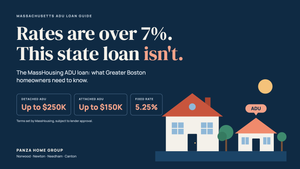
MassHousing offers mortgage financing and down payment assistance programs for eligible Massachusetts homebuyers.
Certain programs advertise assistance of up to $30,000, depending on eligibility and program requirements.
These funds may help qualifying buyers cover some of the upfront expenses associated with purchasing a home.
Assistance amounts, repayment terms, income limits, and other qualifications vary by program.
For renters who have been struggling to save while managing high monthly housing expenses, these programs are worth investigating.
ONE Mortgage Program
Another option is the ONE Mortgage Program, offered through the Massachusetts Housing Partnership.
This program provides affordable financing for eligible first-time homebuyers.
Potential benefits include low down payment requirements and no private mortgage insurance.
For qualifying buyers, eliminating private mortgage insurance can help reduce the monthly cost of homeownership compared with a similar loan that requires it.
Program eligibility depends on factors such as income, property qualifications, and other lending requirements.
The takeaway: Don't assume you need 20% down or perfect credit before exploring your options.
What Does This Mean for Renters in Norwood, Newton, Waltham, and Greater Boston?
Let's look at a realistic scenario.
Suppose you're renting a two-bedroom apartment in Norwood for $3,000 per month.
You're comfortable with your monthly housing payment, have stable employment, and have managed to put some money aside.
But you've avoided looking into buying because you assume you need $100,000 saved before you can even start.
Now imagine you're considering a $600,000 home.
A 20% down payment would be $120,000.
But a 3% down payment would be $18,000.
That's a substantial difference.
And if you're eligible for a Massachusetts down payment assistance program, you may have additional resources available to help with the upfront costs.
Of course, a smaller down payment doesn't automatically mean a home is affordable.
Your monthly mortgage payment, property taxes, homeowners insurance, mortgage insurance when applicable, and maintenance expenses all need to be considered.
You also need to account for closing costs and available cash reserves.
But the important point is this:
The amount you think you need to save before buying may be very different from what your actual financing options require.
That's why having a conversation with a mortgage professional before ruling out homeownership can be so valuable.
Three Things Massachusetts Renters Should Do Before Renewing Their Lease
If you're thinking about buying a home in the next six to twelve months, here are three steps I'd recommend taking now.
1. Find Out Whether Your Rent Payments Are Being Reported
Ask your landlord or property management company whether your rental payments are being reported to the major credit bureaus.
If they're not, ask whether rent reporting is available.
Third-party rent-reporting services may also be an option.
Before enrolling, review the costs, participating credit bureaus, and whether the reporting is likely to benefit the credit scoring models used by your prospective lender.
Remember, reporting rent doesn't guarantee an improved credit score or mortgage approval.
2. Review Your Credit and Financial Situation
Visit AnnualCreditReport.com to obtain your free credit reports.
Review them for errors, incorrect balances, or inaccurate payment information.
Continue making payments on time, keep revolving credit balances manageable, and avoid unnecessarily opening new credit accounts while preparing to purchase.
If your credit history is limited, a mortgage professional can help you identify steps that may strengthen your application.
3. Explore Your Mortgage and Down Payment Assistance Options
Before assuming you're not ready to buy, speak with a qualified mortgage lender.
Ask about conventional low down payment mortgages, FHA financing, MassHousing programs, and ONE Mortgage.
A lender can help you understand your purchasing power, estimated monthly housing costs, and potential assistance eligibility.
Even if you're not ready today, you can establish a realistic plan for the next six months, twelve months, or longer.
Should You Keep Renting or Consider Buying in Greater Boston?
This is one of the most important questions prospective homebuyers should ask.
And the answer depends on your individual circumstances.
Renting offers flexibility, fewer maintenance responsibilities, and the ability to relocate more easily.
Buying offers the potential to build equity, establish long-term housing stability, and benefit from future property appreciation.
However, homeownership also comes with additional financial responsibilities, and property values aren't guaranteed to increase.
For someone paying $3,000 per month in rent, that's $36,000 annually.
Over five years, that's $180,000 in rental expenses, assuming no increases.
That doesn't mean purchasing a home would necessarily cost less.
But it does mean that exploring your options before automatically renewing another lease may be worthwhile.
The goal isn't simply to stop renting. It's to determine whether homeownership makes financial and personal sense for you.
Ready To Find Out If You Could Buy a Home in Massachusetts?
If you're renting in Norwood, Newton, Needham, Waltham, Watertown, Dedham, Canton, Westwood, or anywhere throughout Greater Boston, you may have more options than you realize.
As a Realtor with a background in mortgage lending and experience as a Certified Home Buyer Educator, I understand that buying a home involves more than simply finding the right property.
It's about understanding your finances, exploring available programs, and making informed decisions.
Some buyers are ready to purchase immediately.
Others need six months or a year to prepare.
Both are reasonable starting points.
At Panza Home Group, we help buyers understand the Greater Boston real estate market, connect with experienced mortgage professionals, and develop a homebuying strategy that fits their needs.
Before you renew your lease, let's find out what buying a home could look like for you.
Mike Panza, Realtor®
Panza Home Group | Real Broker MA, LLC
Certified Home Buyer Educator | ABR® | SRES®
Explore Your Homebuying Options at PanzaRealEstate.com
Frequently Asked Questions About Buying a Home in Massachusetts
Can paying rent help me qualify for a mortgage?
Potentially. Some mortgage underwriting programs can consider qualifying rental payment history, and newer credit scoring models such as VantageScore 4.0 can incorporate eligible rental payment information. Whether your payments help depends on the lender, loan program, and availability of verified payment data.
Can I buy a house in Massachusetts with only 3% down?
Yes. Certain conventional mortgage programs allow qualified borrowers to purchase with as little as 3% down. Eligibility requirements vary, and additional closing costs and expenses may apply.
Does Massachusetts offer first-time homebuyer down payment assistance?
Yes. MassHousing offers programs that may provide up to $30,000 in down payment assistance to eligible buyers. Program requirements, funding availability, and assistance terms should be confirmed with a participating lender.
What credit score do I need to buy a home in Massachusetts?
There is no single minimum credit score that applies to every mortgage. Requirements vary by loan type, lender, and underwriting circumstances. Some programs also provide alternative ways to evaluate borrowers with limited traditional credit histories.
Should I speak with a Realtor or mortgage lender first?
Either can be a useful starting point. A mortgage lender can evaluate your financing options, while a local Realtor can help you understand housing prices, neighborhoods, and the overall homebuying process.
Disclaimer: Mortgage programs, credit scoring requirements, and down payment assistance availability are subject to change. All financing is subject to borrower qualification and lender approval. This article is for general educational purposes and does not constitute financial or lending advice.