MassHousing ADU Loan: What Greater Boston Homeowners Need to Know
Oct 16, 2026 · @Michael Panza
Mortgage Rates Are Over 7%. This State Loan Isn't.
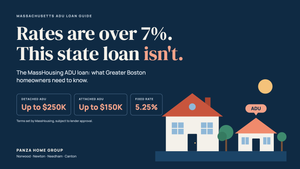
The 30-year fixed mortgage averaged 7.40% as of October 15, 2026, up from 6.27% a year earlier. Meanwhile, MassHousing is offering Massachusetts homeowners a construction loan for an accessory dwelling unit (ADU) at 5.25%.
Almost nobody is talking about it. If you own a home in Norwood, Newton, Needham, Canton, or anywhere in Greater Boston, it could change how you think about the extra space you need.
This guide covers how the loan works, who qualifies, the steps to get started, and the questions to answer before you commit.
What the MassHousing ADU Loan Is
It is a fixed-rate second mortgage that finances construction of a new ADU, offered through MassHousing's network of participating lenders. Applications opened March 17, 2026.
The key terms:
- Detached ADU: up to $250,000 (a backyard cottage, for example)
- Attached ADU: up to $150,000
- Rate: 5.25%, which MassHousing says is lower than a typical home equity line of credit
- Term: the interest-bearing portion amortizes over 20 years
- Extra funding: each loan is paired with additional funding at 0% interest with deferred repayment
- Where you can build: inside your existing home or elsewhere on your lot
The loan is construction-to-permanent financing. It pays for construction, then converts into your long-term second mortgage.
Who Qualifies
The loan is for current homeowners, not for people looking to buy. To qualify, you generally need to:
- Own and live in the home as your primary residence
- Meet the income limit: household income up to 135% of area median income (AMI)
- Pass MassHousing's standard underwriting
- Have designs and permits in hand and be ready to start construction
The state's examples of the 135% AMI limit show how much it varies by region:
| Region | Income limit (135% of AMI) |
|---|---|
| Eastern Massachusetts | $205,335 |
| Worcester County | $165,345 |
| Hampden County | $129,870 |
Income guidelines vary by location and other requirements apply, so confirm your exact limit with a participating lender. Source: MassHousing.
How the Process Works
Permits come first, and the loan comes second. MassHousing expects borrowers to apply once their plans are approved and ready to build.
- Check what your town allows. Zoning, setbacks, and septic or sewer rules vary by town. Start with your local building or planning department.
- Get your design and permits. A separate $10 million program run by the Massachusetts Housing Partnership (MHP) provides technical assistance for design and permitting, and MassHousing points borrowers to it for pre-development work first.
- Talk to a participating lender. You can find lenders and details at masshousing.com/adu.
- Apply with permits in hand. The lender runs the underwriting and confirms the income limit.
- Build. The loan funds construction, then converts to your permanent second mortgage.
Because the design and permitting step takes time, it is worth starting early. Sources: Mass.gov and MassHousing.
What Is an ADU, and What Does State Law Allow?
An ADU is a self-contained second living unit on the same lot as a single-family home. Massachusetts recognizes three types:
- Interior: inside the main house, such as a basement or attic conversion
- Attached: a new addition to the main house
- Detached: a separate building, such as a backyard cottage or a converted garage
Since February 2, 2025, the Affordable Homes Act has allowed ADUs by right in single-family zoning districts across most of the state. Boston has its own zoning and is exempt. The main rules:
- Size: no larger than 900 square feet or half the main home's gross floor area, whichever is smaller
- Entrance: a separate entrance is required
- Parking: towns cannot require a space within a half-mile of a commuter rail, subway, or bus station, or ferry terminal, and can require no more than one space elsewhere
- Permits: towns cannot require a special permit or zoning board approval for the use
- Owner occupancy: towns cannot require it under state law, though this MassHousing loan does
- What towns can still regulate: reasonable rules on setbacks, height, septic, site plan review, and short-term rentals
Details differ slightly between summaries of the law, so confirm the specifics for your lot with your town's building department before you design anything.
Why This Matters for Norwood, Newton, Needham, and Canton Homeowners
Many homeowners are in the same spot: they have a good home and probably a good rate, but they need more space. Moving means giving up that rate and taking on a mortgage above 7%. Building on your own lot is another way to get the space.
An ADU can serve a few purposes:
- Family: space for an aging parent, an adult child, or a caregiver
- Rental: a possible long-term rental unit, subject to your town's rules and the market
- Flexibility: a home office or guest space that can change purpose over time
It will not fit every lot or every budget. Lot size, setbacks, and septic or sewer capacity differ from street to street, and each town applies its own reasonable rules on top of state law.
If you are shopping for a home, lot size and layout are worth asking about too. A property with room to add an ADU later can keep more options open.
What to Confirm Before You Start
The headline terms are public, but a few details are not. Ask a participating lender about each of these before you spend money on design.
- How far the 5.25% rate reaches. Public sources do not say whether it covers the whole loan or only the interest-bearing portion.
- The deferred 0% portion. The state says each loan is paired with 0% funding that is deferred, but it has not published the amount or the deferral period.
- Whether funding is still available. The state has not published a total program amount, and MassHousing's earlier first-time buyer assistance ended early because of demand.
- Your total project cost. Get contractor quotes first. Costs vary widely, and the loan caps are $250,000 for detached units and $150,000 for attached ones.
- Loan-to-value limits. MassHousing says its combined limits are higher than a typical home equity line, so ask how much your home's value supports.
- Taxes and insurance. Ask your assessor and insurance agent how a new unit affects your property tax and coverage.
- Rental income. If you plan to rent the unit, talk to an accountant about how that income is treated.
Frequently Asked Questions
Do I need this loan to build an ADU? No. State law allows ADUs by right in most single-family zones whether or not you use this loan. It is one financing option among several, including a home equity loan or cash.
Is this for first-time homebuyers? No. It is for current homeowners who live in the home they want to add to.
How much will the loan cover? Up to $250,000 for a detached ADU and up to $150,000 for an attached one. Your actual amount depends on your project cost, your home's value, and underwriting.
Can I rent the ADU? State law prevents towns from requiring a special permit for the use or rental of an ADU, but towns can regulate short-term rentals. Confirm your town's rules and the tax treatment of any rental income.
Does the loan work in Norwood, Newton, Needham, and Canton? The loan is a statewide MassHousing program available through participating lenders. Zoning and permitting are handled by each town.
Where do I start? Call your town's building or planning department about what your lot allows, then talk to a participating MassHousing lender.
Next Steps
If an ADU could solve a space problem for your household, take three steps this month:
- Ask your town's building or planning department what your lot allows.
- Get a rough project quote from a contractor or designer.
- Talk to a participating MassHousing lender about your income limit, the rate, and the deferred portion.
If you own a home in Norwood, Newton, Needham, or Canton and want to talk through your options, including what an ADU could mean for your home's long-term value, contact Panza Home Group.
Panza Home Group is not a lender. Loan terms, rates, and eligibility are set by MassHousing, can change, and are subject to lender approval. This post is general information, not legal, tax, or financial advice. Information verified October 16, 2026.
Sources
- MassHousing: ADU Construction Loan Program announcement
- Mass.gov: Governor Healey and MassHousing launch affordable ADU financing
- Banker & Tradesman: MassHousing announces new ADU construction loan program
- Franklin Observer: State-supported mortgages up to $250K for ADUs
- Buyers Brokers Only: ADU loan programs in Massachusetts
- Old Colony Planning Council: Accessory Dwelling Units
- Athol Daily News: By-right accessory dwellings now allowed statewide
- Freddie Mac Primary Mortgage Market Survey, October 15, 2026